
What to Monitor Besides Break-Ins: Water, Temperature, and Critical System Alerts
Meta title: What to Monitor Besides Break-Ins in NH Homes | Pro Technologies
Meta description: Break-ins are only part of the risk. Learn why water, temperature, and critical system alerts matter for New Hampshire homes, lake homes, and second homes.
URL slug: /blog/what-to-monitor-besides-break-ins/
Most people think of a security system as something that helps stop break-ins.
That is still important, but it is only part of the picture. For many New Hampshire homeowners, especially those with larger homes, lake homes, and second homes, the bigger risk is often not an intruder. It is a burst pipe, a failing heating system, a hidden leak, or another problem that goes unnoticed until the damage is expensive and widespread.
That is why smart monitoring today needs to do more than watch doors and windows. It should also help you catch water issues, dangerous temperature drops, and other critical system alerts before they turn into a major repair.
Water damage is one of the biggest threats to a home
A break-in is disruptive. Water damage can be devastating.
A slow leak under a sink, a failed water heater, or a frozen pipe that bursts in the middle of winter can damage floors, walls, cabinetry, and personal property fast. In a primary home, you may catch it early. In a second home or lake home, the damage can continue for hours or even days before anyone sees it.
That is why water monitoring matters.
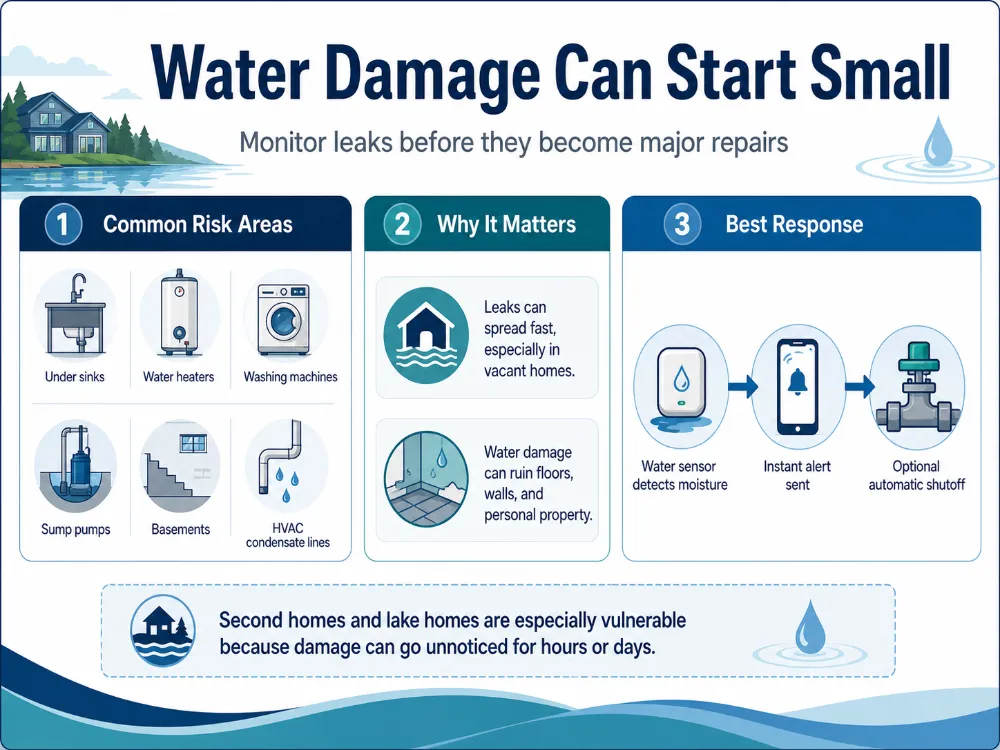
Water sensors can be placed in the areas where problems tend to start, including:
- Under sinks
- Behind washing machines
- Near water heaters
- Around sump pumps
- In mechanical rooms
- Near basement doors and lower-level windows
- Around HVAC equipment and condensate lines
When water is detected, the system can send an alert right away. In some setups, it can do even more by triggering an automatic water shutoff to stop the flow before the damage spreads.
For homeowners who travel often or leave a property empty for part of the year, that kind of protection is worth serious attention.
Temperature alerts help prevent frozen pipes and HVAC failures
In New Hampshire, winter creates a different kind of risk.
A home can look fine from the outside while the temperature inside drops low enough to freeze pipes in a basement, crawl space, utility room, or exterior wall. Once those pipes freeze and burst, the real damage starts when temperatures rise and the water begins to flow.
That is where temperature monitoring becomes essential.
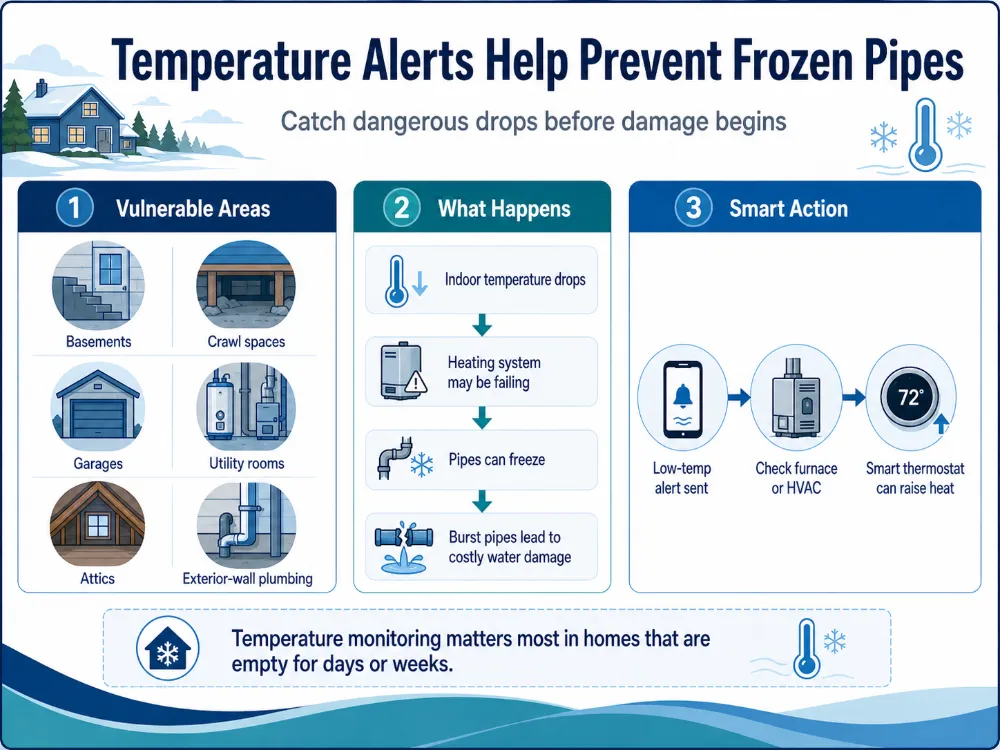
A well-designed security and monitoring system can place temperature sensors in the parts of the home most likely to get cold first, such as:
- Basements
- Crawl spaces
- Garages
- Utility rooms
- Attics
- Rooms above garages
- Areas with plumbing on exterior walls
If the temperature drops toward a dangerous level, you get an alert before the pipe freezes. That gives you a chance to respond early.
For homes with smart thermostats or integrated automation, the system can sometimes do even more. It can raise the heat automatically or trigger another action based on the alert.
That matters most in homes that are not occupied every day. A second home cannot tell you the furnace failed. A properly monitored system can.
Critical system alerts help you catch problems before they get expensive
Not every emergency starts with a break-in or a leak.
Some of the most important alerts come from the systems your home depends on every day. If one of those systems fails, the problem can spread quickly.
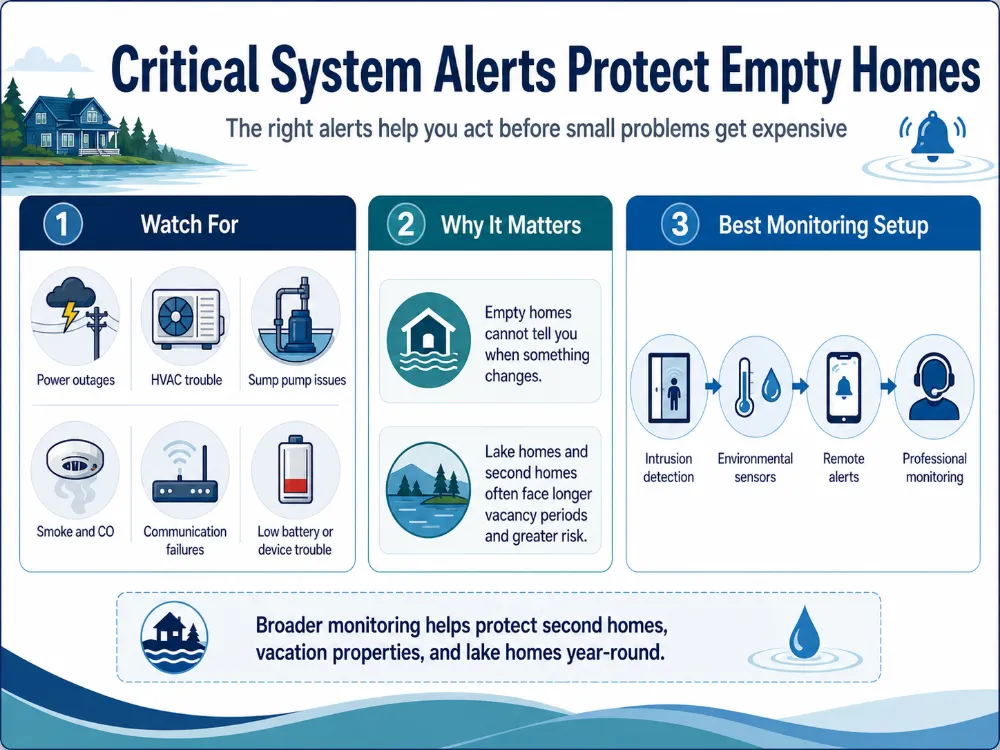
Critical system alerts may include:
- HVAC trouble or extreme indoor temperature swings
- Power outages
- Internet or communication failures in monitored systems
- Low-temperature warnings in mechanical spaces
- Sump pump issues
- Smoke and carbon monoxide events
- Low battery or device trouble conditions
These alerts matter because they tell you the home is changing in a way that may need attention now, not later.
A power outage at your primary residence is an inconvenience. A power outage at a lake home in January can turn into a heating failure, frozen pipes, spoiled food, and a long chain of damage if no one knows about it.
Second homes need broader monitoring than primary homes
If you live in a home every day, you naturally notice when something feels off.
You hear an alarm. You spot water on the floor. You feel the house getting colder. You realize the sump pump is acting strangely.
That everyday awareness disappears when the home is empty.
That is why second homes and vacation properties usually need broader monitoring. You are not just protecting against intrusion. You are protecting against silence.
A good system helps you know when something changes, even when no one is there to see it in person.
For many New Hampshire lake homes and seasonal properties, that means combining intrusion protection with environmental monitoring, remote alerts, and dependable communication paths so the system still works when conditions are not ideal.
Lake homes face unique risks year-round
Lake homes often deal with a different set of conditions than year-round suburban homes.
They may be left vacant longer. They may have more exposure to cold, wind, and moisture. They may include crawl spaces, utility rooms, detached garages, boathouses, and long driveways that make routine checks harder.
That makes environmental monitoring especially useful.
A water sensor near a mechanical room, a temperature sensor in a vulnerable area, and alerts tied to key systems can help you respond before a small issue becomes a major cleanup.
This is not just about convenience. It is about limiting damage, reducing repair costs, and protecting a property that may sit empty during the time it is most vulnerable.
Alerts only matter if they are reliable
A long list of alerts sounds good on paper. It only helps if the system delivers them reliably.
That is one reason professional system design matters. Homeowners often buy smart devices one at a time and end up with a patchwork of apps, weak integrations, and alerts that are easy to miss.
A better approach is to build a system that works together. That means the sensors, alarms, monitoring, and communication paths are designed to support the home as one complete system.
It also means the alerts are meaningful.
You do not want constant noise. You want the right alert, at the right time, for the problems that actually matter.
Professional monitoring adds another layer of protection
Self-monitoring works for some homeowners. But it has limits.
If your phone is off, if you are traveling, if the alert comes in overnight, or if you simply miss the notification, the system cannot help much. That is one reason professional monitoring can be so valuable.
With professional monitoring, important alarm events can be escalated quickly, even if you are not immediately available. For many homeowners, especially those with larger homes or second homes, that added layer of response is worth it.
At Pro Technologies, we also believe flexibility matters. We offer month-to-month monitoring options, not long-term contracts, because protection should make sense for the property and the homeowner.
The best systems are built around the way you live
No two homes have the same risk profile.
A larger year-round home may need broader sensor coverage across multiple levels. A lake home may need stronger outdoor protection and low-temperature monitoring in key utility spaces. A second home may need dependable alerts tied to water, heat, and power conditions because no one is there to catch those issues in person.
That is why a one-size-fits-all kit usually falls short.
A professionally designed system looks at the layout, the weak points, how often the property is occupied, and which problems are most likely to cause costly damage. Then it builds the right mix of intrusion detection, environmental monitoring, and smart alerting around that reality.
At Pro Technologies, we have been protecting New Hampshire homes since 2005. Our team handles the work in-house, and we pre-configure and test systems before installation so they are ready to perform from day one. That matters when you are trusting a system to watch over a home while you are away.
The bottom line
If your security system only tells you about break-ins, it is missing a big part of what threatens a home.
Water damage, frozen pipes, heating failures, power outages, and other critical system issues can create just as much disruption, and often much more expense.
The right monitoring setup helps you catch those problems early, respond faster, and protect your home more completely.
Want a security system that does more than detect intruders?
If you want to monitor water, temperature, and the critical systems that keep your home safe, we can help design a setup that fits your property.
Contact Pro Technologies for a custom consultation and get a system built to protect your home from more than just break-ins.
Your Neighbors, Not a National call center
Free on-site assessment. Detailed proposal. No obligation, no pressure.
CJIS-Certified
FBI-level background clearance
A+ BBB Rated
Better Business Bureau
You Own It
Your equipment from day one
No Contracts
Month-to-month service

Serving Manchester, Nashua, Concord, Bedford, Londonderry, the Seacoast, and communities across New Hampshire.
What Sets Us Apart
We Earn Your Business Every Month.
A month-to-month model only works if service is strong. That’s why we focus on fast response, clean installs, and systems that stay reliable without surprise fees or contract pressure.

No Long-Term Contracts
Month-to-month service with no early termination fees. Stay because we're great, not because you're locked in.

You Own Your Equipment
Every system we install is yours permanently. Switch providers someday and keep every device. Your investment, not ours.

Custom-Designed Systems
No pre-packaged kits. Every system is engineered for your specific property, layout, and lifestyle.

Real People. Real Answers.
Call us on a Saturday, We answer. Steve has personally responded to emergencies on weekends. That's just how we operate.